One of the questions we are asked most often is, “Are your Rottweilers German?”
The simple answer is that there is only one recognized Rottweiler dog breed. The Rottweiler originated in Germany, but terms such as German Rottweiler, American Rottweiler, and Serbian Rottweiler are commonly used to describe dogs from different countries, bloodlines, or breeding programs. They are not separate recognized Rottweiler breeds.
The official FCI breed standard identifies the breed simply as Rottweiler, Standard No. 147, with Germany listed as its country of origin.
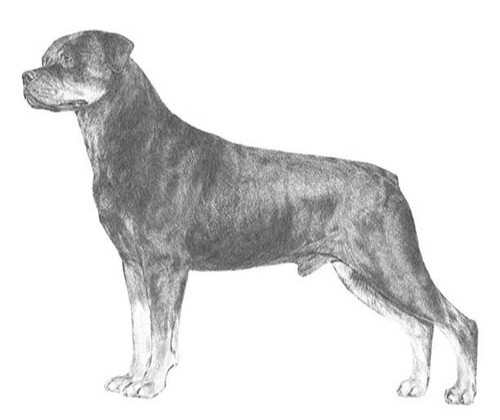
The terms German Rottweiler, American Rottweiler, and Serbian Rottweiler are commonly used online, but they do not represent separate recognized Rottweiler breeds.
A Rottweiler may be born in Germany, the United States, Serbia, or anywhere else in the world. Its country of birth or bloodline does not create a new dog breed. The official breed remains the Rottweiler, with Germany recognized as its country of origin.
The differences people notice in appearance are largely the result of bloodlines, breeder selection, and breeding practices—not separate Rottweiler breeds.
If there is only one Rottweiler dog breed, why can their appearance vary so much?
The answer is breeding selection. Breeders choose which dogs reproduce, and those decisions influence size, head shape, muzzle length, structure, movement, temperament, and other characteristics over generations.
However, different appearances do not create different Rottweiler breeds. The official breed standard defines the proportions and characteristics of a correctly structured Rottweiler.
No separate head shape defines a “German,” “American,” or “Serbian” Rottweiler.
The official breed standards define the correct proportions of the Rottweiler's head and muzzle. The FCI standard states that the muzzle should appear neither elongated nor shortened in relation to the skull. The AKC standard gives a desired backskull-to-muzzle ratio of 3 to 2.
An extremely long or dramatically shortened muzzle does not create a different type of Rottweiler. It should simply be evaluated against the Rottweiler breed standard.
These names are sometimes used to market Rottweilers with exaggerated size or appearance, but they are not separate Rottweiler breeds recognized by the AKC or FCI.
The official standards establish the appropriate size, proportions, and structure of the Rottweiler. The AKC even lists being oversized as a serious fault.
Bigger does not create a new type of Rottweiler—and bigger does not automatically mean better.
You may see red, blue, white, albino, or other unusually colored dogs advertised online as rare Rottweilers. These are not alternative standard Rottweiler colors.
The AKC standard states that the Rottweiler is black with rust to mahogany markings. The FCI standard similarly requires black with clearly defined rich tan markings.
Unusual coloration can occur, but its existence does not make it a recognized Rottweiler color variety.
Long-haired Rottweilers can occur, but long hair does not create another Rottweiler variety or type.
The Rottweiler's correct outer coat is straight, coarse, dense, medium in length, and lying flat. The AKC lists a long coat as a disqualification, while the FCI lists a definitely long or wavy coat as an eliminating fault.
A long-haired Rottweiler can still be a Rottweiler. Its coat simply does not conform to the official breed standard.
Part of this perception may come from Germany's highly structured breeding system.
Within the ADRK, Rottweilers used for breeding must meet specific requirements, including health evaluations and a breeding suitability test known as the ZTP. The purpose of the ZTP is to identify Rottweilers suitable for breeding and exclude unsuitable dogs.
These breeding controls can influence consistency within a breeding program, but they do not create a separate German Rottweiler breed.
This is one of the questions we are asked almost every day.
DKV Rottweilers has worked with German and European bloodlines for decades, including imported dogs and generations developed within our own breeding program.
We use the term German Rottweiler because it is the terminology families commonly use and because the term has become widely associated with correct structure, temperament, and characteristics defined by the Rottweiler breed standard.
We are not breeding a separate “German type” of Rottweiler.
Our goal is simple: to breed a correct Rottweiler.
The difference between the AKC and German ADRK systems goes much deeper than the country in which a Rottweiler was born.
For families who want to understand the standards, breeding requirements, and differences between these systems in greater detail, we have created a separate educational article.