The DKV Rottweiler Education Library is a structured knowledge resource developed for serious prospective owners seeking depth before commitment. This library explores breed standards, temperament evaluation, generational planning, responsible breeder selection, and the long-term realities of owning a correctly bred Rottweiler.
Rottweilers are not a casual acquisition. As a powerful working breed developed for strength, stability, and protective instinct, Rottweilers require informed ownership, structured leadership, and long-term commitment. Education should precede reservation to protect both the family and the dog.
Impulse decisions often lead to mismatched placements. When prospective owners understand what defines correct structure, how temperament is evaluated, and how responsible breeding programs operate, outcomes improve significantly. DKV expects informed ownership, and this library exists to support that standard before any placement decision is made.
Finding the right Rottweiler involves much more than locating an available puppy. Our Rottweiler Puppies for Sale Guide provides a concise introduction to evaluating breeders, understanding health and temperament, choosing an appropriate puppy, and preparing for responsible Rottweiler ownership.
Rottweiler Puppies for Sale: What Families Should KnowFamilies who join the DKV Waiting List receive structured access to an extended educational library developed specifically for approved and committed DKV families. This private library includes detailed program insight, waiting list preparation guidance, puppy development education, training foundations, nutrition principles, and long-term ownership resources.
Access to this extended educational library is provided during the structured waiting period to support preparedness, understanding, and responsible ownership. The categories below illustrate a selection of the educational resources available within the members-only DKV Rottweiler Education Library.









Full access to the members-only DKV Rottweiler Education Library is provided to DKV families on our waiting list and includes all of the educational categories and resources outlined above.
The DKV Rottweiler Education Library continues to expand as new litters, evaluations, and program developments occur. Approved waiting list families receive ongoing access during their preparation period.
Our exclusive DKV Rottweiler Education Library explores many of the core subjects responsible Rottweiler owners should understand before committing to the breed. These materials address breed standards, temperament development, responsible breeder evaluation, structural soundness, and long-term ownership considerations. The following examples illustrate several of the foundational topics discussed throughout the library.
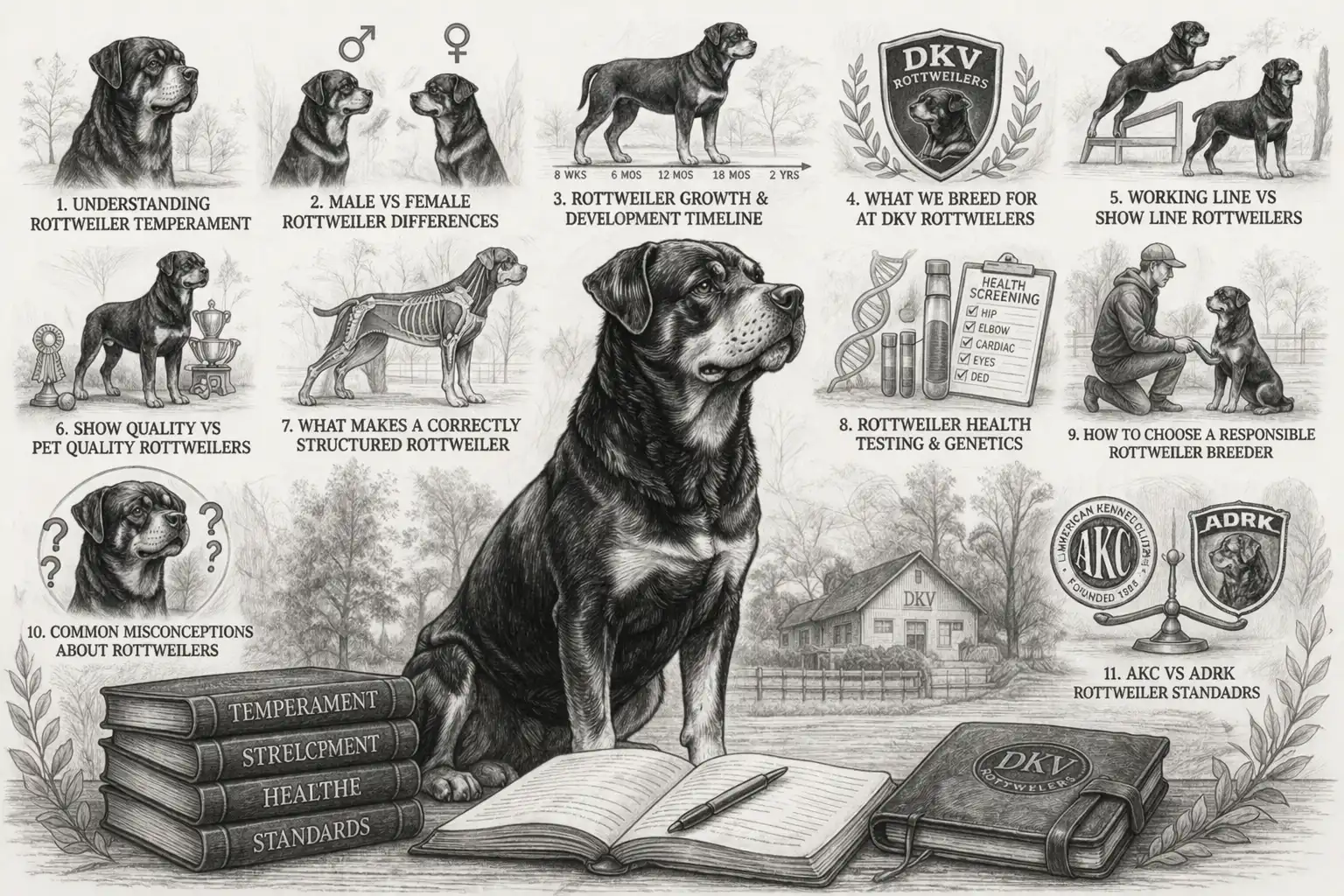
The articles below represent a small selection from the DKV Rottweiler Education Library. Select any title to read a full article, or view the Complete Collection of Public Rottweiler Education Articles for a broader overview of available topics.
Rottweiler breeding should never be reactive. Long-term programs are built on generational planning, structural preservation, and temperament consistency. Each pairing decision must consider lineage strength, health testing integrity, and predictable character development across generations. Correct structure supports longevity and functional soundness, and stable temperament supports responsible placement. At DKV Rottweilers, these decisions are made under Direct Breeder Oversight with preservation prioritized over trend-based demand.
Education must translate into disciplined placement decisions. At DKV, this knowledge connects directly to the Buyer Readiness Experience, the reservation system, and the guided selection process conducted around seven weeks of age for families exploring Available Rottweilers For Sale. Families are not asked to select randomly; selection is supported by breeder evaluation of temperament and development to improve long-term outcomes.
If you have officially joined the DKV Rottweilers Waiting List, click the button below to enter our members-only section of the DKV Rottweilers Education Library and begin your Rottweiler education today.